

Southeast Asia's property market is not short of options; In Phuket alone, more than 700 residential projects were under construction by mid-2025. In Bangkok, household names like Sansiri and Supalai, two of Thailand's largest listed developers, are each targeting upwards of 29 to 36 new project launches in a single year.
Across Vietnam, the Philippines, Cambodia, and Indonesia, the story is the same. More developers, more projects, more noise.
In a market this crowded, having a good product is no longer enough. The real question is whether buyers and investors can trust the developers behind each project, and this is where regional recognition shifts the equation.
There is a difference between a developer promoting their own project and an independent body recognising it. Marketing budgets can produce impressive brochures and compelling showrooms. What they cannot produce is credibility.
As Adam Sutcliffe, Group Head of Events, Southeast Asia Real Estate Awards, puts it: "In today's market, developers aren't just competing on product — they're competing on credibility. Awards give them a third-party validation that directly impacts sales and partnerships."
Thailand real estate awards and Southeast Asia property awards are not marketing tools in the conventional sense; they are external validation. An independent programme, backed by real portal data and assessed by experienced industry consultants, has evaluated a project and found it worthy of recognition. That carries weight in ways that self-promotion cannot replicate.

The impact of regional recognition plays out differently across the three audiences that matter most to a developer's commercial performance.
For end buyers, particularly international buyers purchasing off-plan in a market they do not know well, developer credibility is one of the primary filters. Southeast Asia comprises 11 countries, each with its own legal framework, ownership rules, and market dynamics.
A foreign buyer considering a condominium in Bangkok, a villa in Da Nang, or a development in Cebu is making a significant financial decision with limited local knowledge. An award from a recognised regional programme cuts through that uncertainty, telling the buyer that someone with market expertise has already assessed the developer and the project, and found both to be credible.
For international investors, the calculus is similar but extends to track record and long-term positioning. Institutional and high-net-worth investors increasingly evaluate Southeast Asia as part of a wider regional portfolio. Recognition from a programme covering Thailand, Vietnam, the Philippines, Cambodia, and Indonesia positions a developer within that broader landscape, not just as a local operator, but as a business that meets a regional standard.
For agents, award recognition directly influences which projects they recommend. When advising a buyer across dozens of listings, a recognised Southeast Asia property award serves as a practical shortcut, reducing the due diligence burden and strengthening the agent's confidence in making a recommendation.
In markets where agent networks are a primary sales channel for new developments, that preference translates into referrals and sales velocity.
Asia-Pacific real estate is no longer a market where a rising tide lifts all boats. Growth is becoming selective, buyer behaviour is more discerning, and the best property developers in Southeast Asia are the ones who can differentiate their offering beyond price and location.
That pressure is most visible at ground level. In Thailand, major developers are launching ambitious pipelines into a market navigating tighter lending conditions and shifting buyer sentiment, competing not just on product, but on reputation.
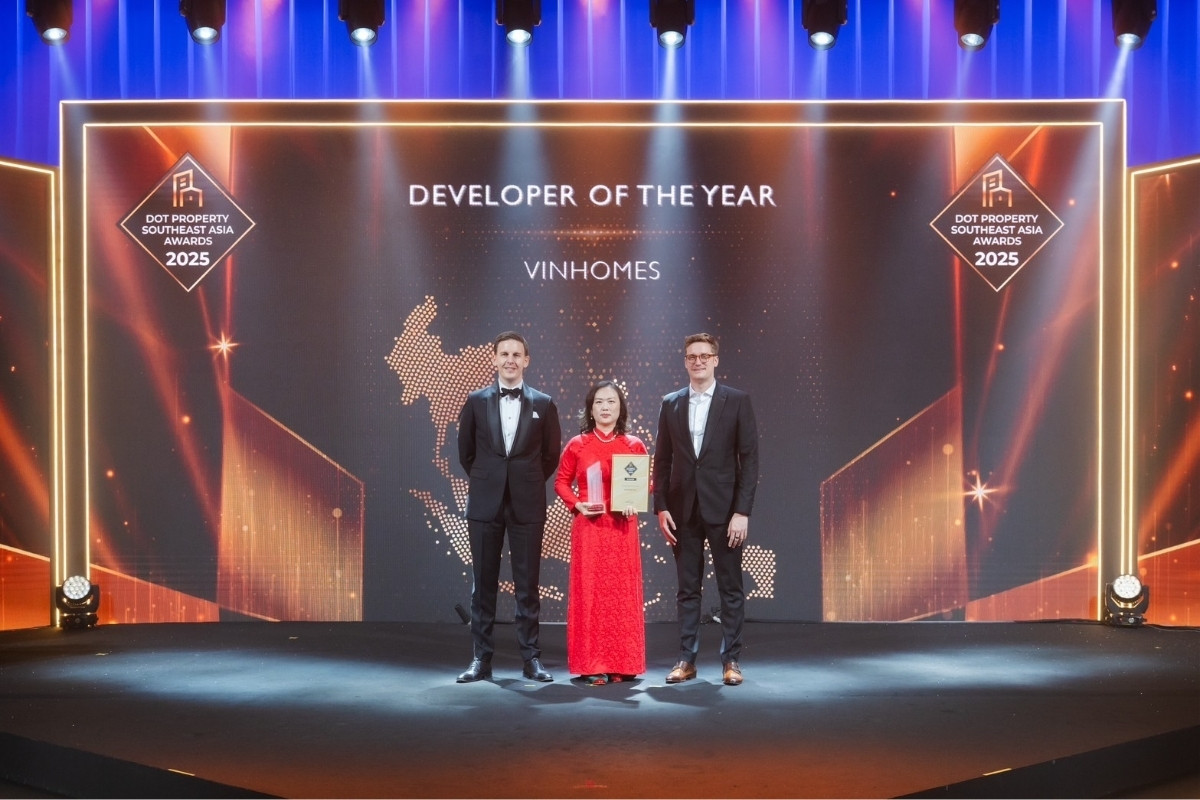
In the Philippines, residential development has expanded rapidly into secondary cities such as Cebu and Davao, with developers competing for the same pool of domestic and international buyers. In Vietnam, a new generation of large-scale developers, among them Vinhomes, named Project of the Year in 2025, is raising the bar for what regional recognition looks like in practice.
In Cambodia, confidence is returning to Phnom Penh after a difficult few years, bringing new developers into a space that is no longer flying under the radar. In Indonesia, Lamudi's market-leading portal presence is drawing more developers into the awards conversation as cross-border buyer interest in Bali and Jakarta grows.
In this environment, a strong local reputation offers diminishing returns when the competition is regional, and the buyers are international. A developer well known in Bangkok may be entirely unknown to a buyer in Singapore, Hong Kong, or London, considering their first Southeast Asian investment. Regional recognition bridges that gap in a way that local brand-building cannot.
The proof is in how past winners have used their recognition commercially.

Anchan Villas, a Phuket-based luxury villa developer, has won at both the Thailand awards and the regional finale, picking up Best High-End Villa Brand and Best Luxury Villa Architectural Design in 2025 alone, building on wins in previous years.
Reignwood Park claimed Thailand Mega Project of the Year at the 2025 Thailand ceremony, recognition that reinforced its positioning as one of the country's most ambitious large-scale developments at exactly the point it was competing for buyer attention against a crowded Bangkok pipeline.
At the regional level, Dusit Central Park was named both Project of the Year and Best Iconic Landmark Development at the 2025 SEA finale, a mixed-use development in Bangkok competing against the best projects across five countries.
The Federal Land of the Philippines took three awards in a single night, generating regional press coverage at exactly the moment it was expanding its project pipeline to new buyers across Southeast Asia.
An award win gives a developer something that marketing spend alone cannot produce: a third-party endorsement they can put in front of a buyer, an agent, or an investor and let it do the talking.
The Southeast Asia Real Estate Awards, backed by Dot Property Group's regional portal network, covers the breadth of the region's most active property markets: Thailand, Vietnam, the Philippines, Cambodia, and Indonesia.
For developers operating in a single market, entry provides exposure to an audience that spans the region. For developers active across multiple markets, it builds a consistent regional profile under one recognised platform.
The programme is free to enter, with the 2026 entry deadline set for May 30. In a market where competition is intensifying, and credibility is the differentiator, Southeast Asia property awards are no longer optional for developers serious about their commercial performance.
Enter the Southeast Asia Real Estate Awards 2026 — entries close 30 May